
You usually start paying your regular mortgage after the new home is legally completed and the purchase closes. For most builder homes, the mortgage funds on closing. Pre-construction condos may have an interim occupancy period before the mortgage starts, while custom builds can involve interest payments on construction funds released during the build. [1] [2] [3]
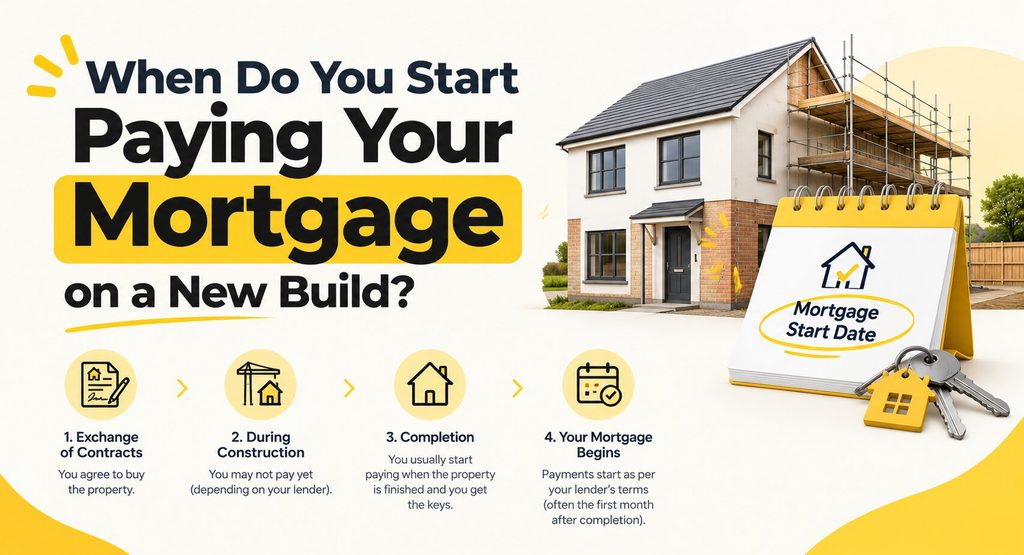
When Does the Mortgage Start on a New Build?
The answer depends on how you are buying or building the home.
A new-build buyer generally falls into one of three situations:
| Type of new build | What you pay before completion | When the regular mortgage starts |
| Pre-construction condo or townhome | Builder deposits and possibly occupancy fees | Final closing |
| Builder-built or turnkey home | Builder deposits | Closing and mortgage funding |
| Custom self-build | Construction financing interest on funds drawn | Regular mortgage after construction financing converts |
The key difference is whether you are buying a home from a builder or financing the construction yourself.
A standard builder purchase usually does not require you to make regular mortgage payments while the property is being constructed.
Do You Pay a Mortgage While a New Home Is Being Built?
Usually, no.
If you purchase a new home from a developer or builder, you normally pay the deposits required under your purchase agreement while construction is underway. Your mortgage is arranged for the eventual closing, but the lender does not normally advance the mortgage until that closing takes place.
This type of financing is often referred to as a completion mortgage.
The basic timeline is:
Purchase agreement → builder deposits → construction → mortgage financing → closing → mortgage funding → regular mortgage payments
You can therefore buy a home well before it is finished without making monthly mortgage payments on the property during the entire construction period.
That does not mean there are no costs before closing. Deposits, upgrades, legal costs and other expenses can require substantial cash before the mortgage begins.
When Do Mortgage Payments Start on a Pre-Construction Condo?
Pre-construction condos can have a different timeline because you may be able to move into the property before final closing.
The building can become ready for occupancy before the condominium is fully registered and your individual unit is transferred into your name.
This creates an interim occupancy period.
During interim occupancy, you may receive the keys and live in the unit, but your regular mortgage has not necessarily started.
Instead, the builder may charge an occupancy fee where permitted by the applicable provincial rules.
Once final closing occurs, the mortgage funds and your normal mortgage payments begin.
What Is Interim Occupancy?
Interim occupancy is the period between the time you are allowed to occupy your new unit and the time the purchase is legally completed.
This is most commonly associated with pre-construction condominiums.
The important point is that occupancy and ownership are not necessarily happening on the same day.
You could therefore have:
Move-in date → interim occupancy → final closing → mortgage starts
The length of the interim period depends on the development and the applicable provincial rules.
Are Interim Occupancy Fees the Same as Mortgage Payments?
No.
An occupancy fee is not the same as a regular mortgage payment.
During interim occupancy, the builder may charge an amount based on components such as interest on the unpaid purchase price, estimated property taxes and common expenses, depending on the applicable rules.
Your regular mortgage has not yet been funded, so you are not making the normal principal-and-interest payment that applies after closing.
This distinction matters when you calculate the actual cost of buying a pre-construction condo.
What Happens at Final Closing?
Final closing is when the purchase is legally completed.
The mortgage lender provides the mortgage funds needed to complete the transaction, subject to the lender’s final requirements.
Your ownership is transferred according to the purchase documents, and your mortgage becomes an active loan secured against the property.
Your regular payment schedule then begins according to the mortgage agreement.
The exact date of your first mortgage payment may be after the closing date rather than on the same day. Your lender will give you the payment schedule.
When Do You Start Paying a Mortgage on a New Builder Home?
A completed or nearly completed builder home usually follows a simpler process.
You sign the purchase agreement, make the required deposits, and wait for construction to finish.
Your mortgage is generally funded when you legally close on the property.
For example:
September: Purchase agreement signed
September–June: Construction and builder deposits
June: Final mortgage arrangements
July: Closing and possession
After closing: Regular mortgage payments according to the lender’s schedule
The exact timeline depends on the builder, purchase agreement and lender.
The important distinction is that your deposit is not a mortgage payment.
You may have paid the builder thousands of dollars before closing without having made a single mortgage payment.
What Is a Completion Mortgage?
A completion mortgage is financing arranged for a home that will be completed in the future.
The builder may require you to demonstrate that you have mortgage financing available before construction is complete. This gives the builder confidence that you will be able to complete the purchase.
However, the lender does not normally advance the full mortgage amount simply because you have received a pre-approval.
The mortgage funds when the transaction reaches the required closing stage.
This is why a buyer can have a mortgage pre-approval months before making the first mortgage payment.
How Early Should You Get Mortgage Approval for a New Build?
You may need financing information well before your actual closing date.
A builder can ask for a mortgage pre-approval or other evidence that you are financially capable of completing the purchase.
The challenge is that a new-build closing date may be many months away.
Mortgage rates and your financial circumstances can change during that period. Your income, debts, employment, credit profile and other information may also need to be reviewed again closer to closing.
A rate hold can protect a borrower for a specified period, but standard rate holds do not normally last indefinitely.
A commonly used mortgage rate-lock period is around 120 days, although the actual period depends on the lender and mortgage product.
If your home is more than 120 days from completion, ask your lender or mortgage professional how the financing will be handled.
What Happens If the Builder Delays Closing?
A construction delay can create a mortgage problem even if you were fully approved when you originally bought the home.
For example, suppose your builder originally expects the home to be ready in July. You arrange your financing around that date.
The builder then delays completion until October. Your original rate hold or mortgage approval may no longer cover the new closing date. The lender may need to extend the financing, update your application or reassess the mortgage.
Contact your lender as soon as you receive a significant construction-delay notice.
Do not assume that your original approval automatically remains valid until the new closing date.
Do You Pay a Mortgage on a Custom-Built Home While It Is Being Built?
You can have mortgage-related payments during construction if you use a construction or draw mortgage.
A custom self-build works differently from purchasing a new home from a developer.
Instead of the builder financing construction and you paying deposits until closing, the lender can release money to finance construction in stages.
These advances are called draws.
A typical construction project might have financing released after stages such as:
- Foundation work
- Framing and roofing
- Exterior enclosure
- Interior work
- Final completion
The exact draw schedule depends on the lender and project.
The lender may require an inspection before releasing the next draw. The inspection confirms that the required construction stage has been completed.
How Do Construction Mortgage Payments Work?
Many construction mortgages use an interest-only payment structure during the construction period.
You generally pay interest on the amount that has actually been advanced rather than on the entire approved construction mortgage.
For example, imagine a lender approves $500,000 for your construction project.
The first draw might provide $100,000.
Your interest during that stage would be based on the amount actually borrowed, according to the terms of your construction mortgage.
A later draw could increase the outstanding balance to $225,000. Your interest cost would then increase because more of the mortgage has been advanced.
This process continues as construction progresses. Once the home is complete, the construction financing can transition into a regular mortgage with principal-and-interest payments.
Construction Draw vs. Interest-Only Payment Timeline
Construction mortgage funds are released in stages. Interest-only payments generally increase as more of the approved mortgage is drawn.
Example draw percentages shown are 15%, 25%, 25%, 20% and 15%. Actual construction draw schedules vary by lender and project.
What Is the Difference Between a Construction Mortgage and a Regular Mortgage?
The biggest difference is when the lender releases the money.
| Construction mortgage | Regular purchase mortgage |
| Money is released in stages | Mortgage generally funds at closing |
| Used for construction projects | Used to purchase a completed property |
| Interest may be paid during construction | Regular principal-and-interest payments follow funding |
| Inspections may be required before draws | No construction draw schedule |
| Can transition to permanent financing | Already structured as permanent mortgage financing |
A construction mortgage is therefore not simply a regular mortgage that starts earlier.
It is a different financing structure designed around the fact that the property is still being built.
How Much Down Payment Do You Need for a New-Build Mortgage?
There is no single down-payment requirement for every type of new-build mortgage.
A buyer purchasing a builder home can have different financing options from someone constructing a custom home.
Construction mortgages can also have stricter lender requirements because the lender is financing a property that is not yet complete.
Some construction lenders may require a substantial equity contribution. The amount can depend on the land, construction budget, projected completed value, borrower finances and lender policy.
For an ordinary home purchase, the down payment also affects whether mortgage insurance is required and which amortization rules apply.
Do not assume that the down-payment requirement for a standard purchase automatically applies to a custom construction mortgage.
Can You Get a 30-Year Mortgage on a New Build in Canada?
Eligible buyers purchasing a newly built home can qualify for an insured mortgage with an amortization of up to 30 years under the rules that took effect December 15, 2024.
The expanded rules also cover eligible first-time homebuyers. The 30-year option is subject to the requirements for insured mortgage financing and does not automatically apply to every new-build purchase.
The change increased the maximum amortization available to qualifying borrowers from the previous 25-year limit in applicable situations.
A longer amortization can reduce the required monthly payment.
The trade-off is that keeping the mortgage for the full longer amortization can result in more interest paid over time.
25-Year vs. 30-Year Mortgage: Payment and Interest
A longer amortization can reduce the required monthly payment, but it can increase the total interest paid if the mortgage remains outstanding for the full amortization period.
Monthly Mortgage Payment
Total Interest Paid
This illustration assumes the same interest rate remains in effect for the entire amortization period. Actual Canadian mortgages are renewed during the amortization period, so actual lifetime interest will depend on future rates, payment changes and prepayments.
What Is the Difference Between Mortgage Term and Amortization?
These two terms are often confused.
The mortgage term is the period covered by your current mortgage contract. A five-year term, for example, does not mean you have a five-year mortgage that will be completely paid off in five years.
The amortization period is the longer period used to calculate how long it would take to repay the mortgage in full if the payment and interest assumptions remained unchanged.
You could therefore have:
30-year amortization + 5-year mortgage term
At the end of the five-year term, you would normally renew, refinance or pay off the remaining mortgage balance.
What Costs Should You Budget Before Your Mortgage Starts?
Your mortgage may not start for months after you sign the purchase agreement, but that does not mean you can ignore the costs during that period.
A new-build buyer may need money for:
- Builder deposits
- Upgrades
- Legal fees
- Closing adjustments
- Inspections
- Appliances or other items not included in the base price
- Landscaping or fencing
- Moving expenses
Your purchase agreement should clearly identify what is included in the base price and what costs extra.
Ask about upgrades before signing because some features can be much easier to finance as part of the original purchase than after the home is completed.
A finished basement or basement suite is a good example. If the builder offers it as part of the home’s construction package, ask your lender how that cost will be treated for financing and property valuation purposes.
How Can You Prepare for a New-Build Mortgage?
A long construction timeline gives you time to improve your financial position.
If you are carrying consumer debt, reducing that debt before the final mortgage application can improve your overall debt position.
Saving additional cash can also help with closing costs and unexpected expenses.
Keep your financial documents organized throughout the construction period. Your lender may need updated information closer to closing, particularly if the original mortgage approval was completed many months earlier.
It is also worth asking your lender these questions before you commit:
| Question | Why it matters |
| When will my mortgage actually fund? | Confirms when regular mortgage financing begins |
| How long is my rate hold? | Helps you plan for long construction periods |
| What happens if the builder delays closing? | Prevents surprises if possession moves |
| Will my application be reassessed? | Your financial situation may change |
| What costs must I pay in cash? | Helps you avoid a closing-day cash shortage |
| Is this a completion or construction mortgage? | Determines how funds and payments work |
Frequently Asked Questions
Do I pay a mortgage during interim occupancy?
Usually, no. During interim occupancy, you may pay an occupancy fee instead of a regular mortgage payment. The mortgage normally begins after final closing and mortgage funding.
How long can interim occupancy last?
There is no single period that applies to every new-build property across Canada. The length depends on the project, construction progress, registration and the provincial rules governing the purchase.
Can I get a mortgage before my new home is finished?
Yes. You can arrange financing or obtain a pre-approval before construction is complete. The mortgage itself generally does not start until the lender advances the funds at closing, unless you are using construction financing.
What happens if my mortgage pre-approval expires before closing?
Contact your lender or mortgage professional. The financing may need to be extended, updated or reassessed. Construction delays can move the closing date beyond the original approval or rate-hold period.
Do I make interest payments on a construction mortgage?
You may. Many construction mortgages require interest payments on the funds that have been advanced during the construction period. The exact payment structure depends on the lender and mortgage agreement.
Can I buy a new build more than a year before it is finished?
Yes. Pre-construction purchases can be made well before completion. You normally pay deposits according to the purchase agreement and arrange or update your mortgage financing closer to closing.
Does the builder deposit count toward my down payment?
The deposits you pay under the purchase agreement generally form part of the money you have contributed toward the purchase. Your lender will determine how the deposit is treated when calculating the final mortgage and down payment.
What Should You Ask Your Mortgage Professional Before Buying a New Build?
The most useful question is:
“When will my mortgage start, and what will I have to pay before then?”
The answer should be clear enough for you to map out the entire financing timeline.
For a builder purchase, confirm the expected closing date, mortgage funding date, rate-hold period and what happens if construction is delayed.
For a pre-construction condo, ask specifically about interim occupancy and the expected period between occupancy and final closing.
For a custom build, ask about the construction draw schedule, inspection requirements, interest payments and how the construction mortgage converts to permanent financing.
Your final timeline should make the difference between these stages clear:
Purchase agreement → deposits → construction → occupancy, if applicable → final closing → mortgage funding → first mortgage payment
Once those dates are clear, you can work out how much cash you need before the mortgage begins and what your regular housing costs will be after closing.