
Your dream home can feel within reach until your mortgage pre-approval comes back lower than expected. A smaller approval can force you to reconsider the property you want, increase your down payment, or delay your home purchase. But a low per-approval does not always mean you need a higher salary or a cheaper home.
Your maximum mortgage amount depends on several factors, including your income, existing debts, credit profile, down payment, property costs, interest rate, and the lender’s affordability rules. In Canada, the mortgage stress test can also affect how much you qualify to borrow. In the U.S., lenders use different debt-to-income requirements and loan-program guidelines.
The key is to identify what is actually limiting your borrowing power. Paying down the right debt, documenting additional qualifying income, improving your credit profile, increasing your down payment, choosing an appropriate amortization period, or comparing lenders could increase the amount you qualify for.
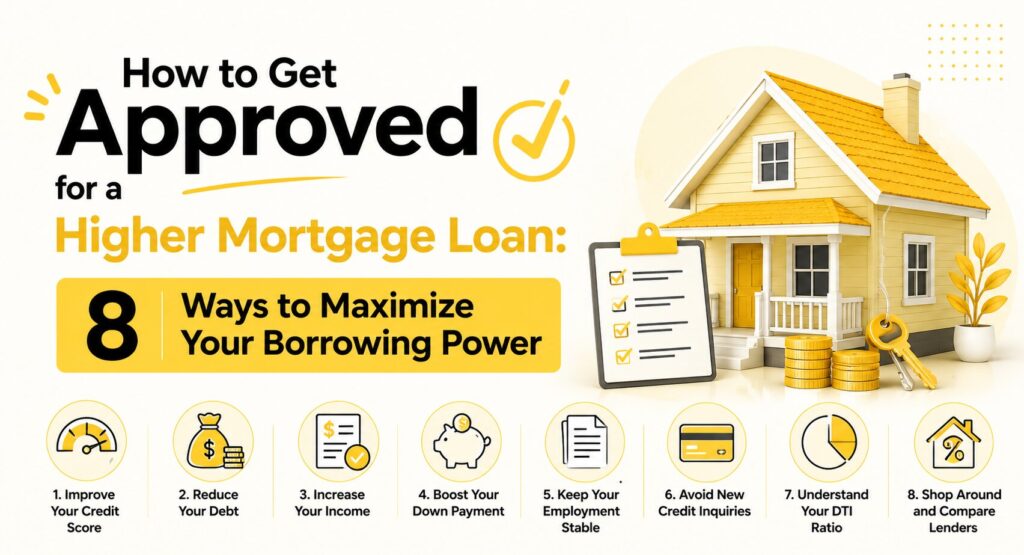
8 Practical Ways To Get Approved For A Higher Mortgage Loan
Below, we will explain 8 practical ways to get approved for a higher mortgage loan, along with the common mistakes that can reduce your borrowing power.
1. Lower Your Debt-to-Income and Debt Service Ratios
One of the most effective ways to qualify for a higher mortgage is to reduce the debt payments that appear on your application.
In the U.S., lenders commonly use a debt-to-income ratio (DTI). It compares your monthly debt obligations with your gross monthly income. Different mortgage programs and lenders have different limits. For example, Fannie Mae’s guidelines specify different maximums depending on how a loan is underwritten and the borrower’s overall qualifications.
Canada uses Gross Debt Service (GDS) and Total Debt Service (TDS) ratios for insured mortgage qualification.
GDS looks at housing costs such as:
- Mortgage principal and interest
- Property taxes
- Heating costs
- Applicable condo fees
- TDS adds other debt obligations such as:
- Credit cards
- Car loans and leases
- Lines of credit
- Personal loans
- Student loans
CMHC’s standard maximums for insured mortgages are generally 39% for GDS and 44% for TDS.
Why paying off debt can increase your mortgage amount?
Suppose you have a $500 monthly car payment.
That payment reduces the amount of monthly income available for your proposed mortgage. If you pay off the car loan before applying, the lender may have more room to approve a larger mortgage.
The same principle applies to credit cards, personal loans and other recurring obligations.
However, don’t automatically drain your savings to pay off every debt. The better strategy is to compare the monthly qualifying payment you eliminate with the cash you would use to eliminate it.
If paying off a $10,000 loan removes a substantial monthly obligation, it could have a much bigger impact on mortgage qualification than simply keeping that $10,000 in a savings account.
2. Proactively Reduce Unused Credit Limits
Unused credit can create confusion because a credit card with a $0 balance does not necessarily mean the account is irrelevant to underwriting.
The treatment of available credit varies by lender, mortgage program and country. Lenders generally review your credit accounts and existing obligations as part of the application. In Canada, CMHC’s underwriting guidance focuses on outstanding revolving balances and requires a minimum payment calculation for unsecured credit cards and lines of credit.
So don’t assume that every unused credit card will automatically reduce your borrowing power. Instead, ask your lender or broker how your available revolving credit is being treated in your specific application.
If you have several old cards or large unused lines of credit that you don’t need, you can ask whether:
- Closing an unused account would help
- Reducing the credit limit would help
- Keeping the account open but reducing the balance is preferable
- The account has any effect on your lender’s underwriting calculation
- Don’t close accounts blindly
- Closing a credit card can sometimes affect your credit history or utilization ratio.
If you’re already close to applying for a mortgage, ask your lender before making major changes. The goal is not to make your credit profile look smaller. The goal is to remove unnecessary liabilities without creating a new problem.
3. Optimize and Document All Qualifying Income Streams
If your mortgage approval seems low compared with your actual household income, the lender may not be able to use all of your income for qualification.
Your salary is usually the easiest income to document. Other income can be more complicated.
Depending on the lender and mortgage program, potentially qualifying income may include:
- Overtime
- Bonuses
- Commissions
- Part-time employment
- Self-employment income
- Rental income
- Certain investment income
- Other recurring income sources
- The key issue is stability and documentation.
For example, someone earning $90,000 in salary plus irregular freelance income cannot necessarily expect a lender to treat every dollar of freelance income as permanent qualifying income.
Self-employed borrowers can face additional documentation requirements. In Canada, lenders may request Notices of Assessment and other tax documents, while U.S. lenders may examine tax returns and business financial information depending on the circumstances.
How to make more of your income count?
Before applying, gather documentation showing:
- How long you’ve earned the income
- Where it comes from
- Whether it is recurring
- Your recent pay
- Your tax history where applicable
- Employment status and tenure
- Supporting bank or business records when required
If you’re expecting a promotion, changing jobs, or moving from salaried employment to self-employment, talk to your lender before making the change.
A higher nominal salary does not always produce a higher qualifying income if the new income is difficult to verify.
4. Understand Mortgage Stress Test and Qualifying Rate
This is particularly important for Canadian borrowers.
A lender doesn’t necessarily qualify you using the mortgage interest rate you see in the offer.
For uninsured mortgages at federally regulated Canadian lenders, the current Minimum Qualifying Rate (MQR) is the greater of:
Your mortgage contract rate + 2 percentage points, or 5.25%
OSFI currently requires this stress test for most newly underwritten uninsured residential mortgages by federally regulated lenders.
CMHC-insured mortgages also use the greater of the contract rate plus 2% or 5.25% when calculating GDS and TDS.
Why does the qualifying rate matter?
Imagine two borrowers have identical incomes and debts.
If one mortgage qualifies at a lower effective qualifying payment because of the applicable mortgage product and rate, that borrower may have more borrowing capacity.
This is one reason it can be useful to compare lenders rather than assuming your first per-approval represents your maximum possible mortgage.
For U.S. borrowers, the system is different. There is no Canadian-style nationwide 5.25% + 2% mortgage stress-test rule. Instead, lenders evaluate the loan under the applicable underwriting rules, including the qualifying payment, DTI, credit profile, assets and loan program.
That distinction matters when reading mortgage advice online. A strategy that increases borrowing capacity in Canada may not work the same way in the United States.
5. Improve Your Credit Score and Credit Profile
A better credit profile can improve your mortgage options, although it does not automatically guarantee a larger loan.
Lenders look at more than your credit score. They can also consider your credit history, outstanding debt, income, assets and other financial information. The CFPB notes that credit scores can affect both mortgage eligibility and the interest rate offered to borrowers.
Before applying, check your credit reports for errors.
Also:
- Pay every account on time
- Keep revolving balances under control
- Avoid unnecessary new credit applications
- Don’t take out a new personal loan just before applying
- Avoid large unexplained changes in your credit profile
- Pay down high-interest revolving debt where practical
Is 680 or 700 a magic number?
Not exactly.
A particular credit-score threshold may matter for a particular mortgage program, but no universal score guarantees a higher mortgage amount in both Canada and the U.S.
A stronger credit profile can help you qualify for better pricing or a broader range of mortgage products. But if your main problem is excessive monthly debt, increasing your score by a few points may not materially increase your borrowing capacity.
Fix the factor that is actually limiting your application.
6. Consider a Longer Amortization or Loan Term Where Appropriate
Extending the repayment period can reduce the required monthly payment, which can improve affordability calculations. But the rules are different in Canada and the U.S.
In Canada, For insured mortgages with less than 20% down, a maximum amortization of 30 years is available to eligible first-time homebuyers and buyers of new builds. Other borrowers may have different limits depending on the mortgage and down payment.
A longer amortization can reduce the monthly payment and therefore potentially improve your debt-service ratios. The trade-off is that you may pay more interest over the life of the mortgage.
In United States, 30-year mortgages are already common in the U.S., so moving from a shorter amortization structure to a 30-year loan can have a substantial effect on monthly affordability, depending on the loan program.
However, don’t choose a longer repayment period solely to maximize the amount a lender will approve.
The question should be:
Can I comfortably afford the payment, not just pass the lender’s calculation?
A larger approval can give you more purchasing power, but it can also leave you with less room for repairs, taxes, insurance, emergencies and other expenses.
7. Add a Co-Borrower or Co-Signer
Another way to increase mortgage borrowing capacity is to apply with someone whose qualifying income and financial profile strengthen the application.
A co-borrower may contribute:
A co-borrower may contribute:
- Employment income
- Self-employment income
- Assets
- Strong credit
- Additional borrowing capacity
This can be particularly useful when one applicant has a strong income but doesn’t qualify for the desired mortgage amount alone.
However, adding someone to a mortgage isn’t simply a way to make the numbers work.
Depending on the mortgage and jurisdiction, the person may become legally responsible for the debt. Their own ability to borrow in the future can also be affected.
Co-borrower vs. guarantor
These terms are not interchangeable.
A co-borrower generally has a direct role in the mortgage obligation and may also have an ownership interest in the property.
A guarantor may support the application without necessarily becoming an owner, depending on the lender and legal structure.
The exact treatment varies by lender and jurisdiction, so ask how the person will appear on:
- The mortgage
- The property title
- The loan application
- Future refinancing documents
- Don’t add a family member simply because a lender says it will increase your approval.
You must understand what financial responsibility you’re giving them.
8. Shop Around With Different Lenders
This is one of the most overlooked ways to potentially increase your mortgage approval.
Two lenders can look at the same borrower and reach different conclusions because their underwriting policies, income calculations, mortgage products and risk appetites differ.
In Canada, a mortgage broker can provide access to multiple lenders, although every broker has a different lender network. The Financial Consumer Agency of Canada specifically recommends comparing lenders and notes that brokers may provide access to a wider range of mortgage products.
The same principle applies in the U.S. The CFPB recommends comparing multiple lenders and says shopping around can save borrowers money.
Compare more than the maximum mortgage
Suppose:
Lender A approves $650,000
Lender B approves $700,000
Lender C approves $725,000
The highest approval isn’t automatically the best deal.
Compare:
- Interest rate
- Monthly payment
- Mortgage insurance
- Closing costs
- Prepayment terms
- Fixed vs. variable/adjustable structure
- Amortization
- Penalties
- Fees
- Rate-lock terms
- Total borrowing cost
The goal is to find the highest mortgage you can reasonably afford on acceptable terms, not simply the lender willing to give you the biggest number.
Can Savings Help You Get Approved for a Higher Mortgage?
Yes, savings and assets can matter, but they don’t always work as a substitute for income.
A lender may look at your:
- Down payment
- Cash reserves
- Investment accounts
- Retirement assets
- Other property
- Liquid assets
- Closing-cost funds
Canada’s FCAC says lenders consider assets, income and debt during preapproval, and may request recent bank or investment statements.
In the U.S., the CFPB similarly notes that lenders consider savings and total assets along with income, debt and credit.
However, having $300,000 in investments does not automatically mean a lender will let you borrow an additional $300,000.
Some lenders and private-bank or high-net-worth programs may give greater weight to substantial liquid assets. The treatment depends on the lender.
If you have substantial savings but your income appears too low for the mortgage you want, ask specifically whether the lender has an asset-based, wealth-management or high-net-worth lending program.
A standard online mortgage calculator may not capture these options.
What About a Larger Down Payment?
A larger down payment can help in several ways.
It reduces the amount you need to borrow and lowers your loan-to-value ratio.
For example:
$800,000 home
10% down = $80,000
Mortgage = $720,000
With 20% down:
Down payment = $160,000
Mortgage = $640,000
The second borrower needs a smaller mortgage, which can make affordability easier.
A larger down payment can also reduce or eliminate mortgage insurance requirements in situations where mortgage insurance applies.
Don’t put every dollar of savings into the down payment just to qualify for a larger house.
You still need money for:
- Closing costs
- Moving expenses
- Emergency savings
- Repairs
- Property taxes
- Insurance
- Furniture and other immediate expenses
A lender may approve the mortgage, but you still need to live with the payment.
Common Mistakes That Can Shrink Your Mortgage Approval
If you’re trying to maximize your mortgage amount, avoid making major financial changes during the application process.
Common mistakes include:
- Taking out a car loan before closing
- Opening new credit cards
- Increasing credit-card balances
- Changing jobs without discussing it with your lender
- Making large unexplained cash deposits
- Taking on personal loans
- Ignoring lease payments
- Failing to document side income
- Using borrowed money for a down payment when the lender does not permit it
- Assuming a preapproval guarantees final approval
- Applying with only one lender
- Spending your entire savings on the down payment
A preapproval is not necessarily a final mortgage approval.
In Canada, FCAC explicitly states that a preapproval does not guarantee final approval and that the property itself must meet the lender’s requirements.
The CFPB makes a similar distinction in the U.S., describing a preapproval as an indication that a lender is willing to lend subject to further confirmation.
How to Diagnose Why Your Mortgage Approval Is Too Low?
Before trying all eight strategies, find out which number is actually stopping you.
Ask your lender or broker:
Is my income the limiting factor?
If yes, investigate whether additional stable income can be documented and included.
Is my debt ratio too high?
If yes, focus on the debts with the largest monthly payments.
Is my credit profile limiting the application?
If yes, correct report errors, reduce balances and avoid new credit.
Is the stress test limiting me?
This is particularly relevant in Canada. Ask what qualifying rate is being used and how it affects your maximum loan amount.
Is the down payment the problem?
If yes, consider whether additional savings, a permitted gift, or another legitimate source of funds can strengthen the application.
Is the lender’s policy the problem?
If your finances look strong but one lender won’t reach your target, another lender may calculate your application differently.
This diagnostic approach is much better than randomly paying down debts or moving money between accounts.
If your mortgage preapproval is lower than you expected, don’t immediately assume you need a higher income. Start by identifying the constraint.
Lower your monthly debt obligations. Document all eligible income. Keep your credit profile clean. Understand the qualifying rate. Consider an appropriate amortization period. Explore a co-borrower when it genuinely makes sense. Strengthen your down payment and assets. Then compare multiple lenders.
For Canadian borrowers, the GDS/TDS ratios and mortgage stress test can have a major effect on borrowing capacity. For U.S. borrowers, the relevant DTI limits, credit requirements and qualifying rules depend heavily on the loan program and lender.
Most importantly, don’t confuse the largest mortgage a lender will approve with the largest mortgage you can comfortably afford.
Frequently Asked Questions
How much more mortgage can I get if I pay off my car loan?
There is no universal dollar amount.
The impact depends on your income, interest rate, remaining loan balance, monthly payment, existing debt and the lender’s affordability calculation.
What matters is that eliminating a monthly debt payment can create more room in your qualifying ratios. In Canada, vehicle loans and leases are included among the debt obligations used in TDS calculations.
Ask your lender to recalculate your maximum mortgage with and without the car payment. That gives you a much more useful answer than a generic online estimate.
Does a higher credit score automatically mean a bigger mortgage?
No.
A higher credit score can improve your eligibility and potentially your mortgage pricing, but your maximum borrowing amount is also affected by income, debts, property costs, down payment and the lender’s underwriting rules.
If your debt-to-income or debt-service ratio is already the limiting factor, a higher credit score alone may not increase the mortgage amount significantly.
Can I use future rental income to qualify for a higher mortgage?
Potentially, but the amount a lender will recognize depends on the mortgage program, property and documentation.
Rental income is treated differently by different lenders. In Canada, CMHC has specific approaches for rental income when calculating debt-service ratios.
Don’t assume that 100% of expected rent will automatically be counted as qualifying income.
Ask the lender how much of the rental income they will use before relying on it to increase your home-buying budget.
Does having more savings help me qualify for a bigger mortgage?
It can, but it depends on the lender.
Savings can strengthen your application by providing a larger down payment and demonstrating financial reserves. Some specialized lenders may also have programs that place greater emphasis on significant liquid assets.
However, standard affordability calculations generally still focus heavily on income and debt.
Can a mortgage broker get me a higher approval?
A broker cannot guarantee a higher mortgage.
What a good broker can do is compare your application against multiple lenders instead of relying on one lender’s underwriting model.
This can be especially useful if your income is self-employed, variable, commission-based or comes from multiple sources.
Should I use all my savings to increase my mortgage approval?
Usually, no.
A larger down payment can reduce your mortgage and improve your loan-to-value ratio, but draining your savings can leave you vulnerable after closing.
Keep enough money for closing costs, emergencies, maintenance and unexpected expenses.
Can I increase my mortgage amount after getting preapproved?
Possibly.
If your financial situation improves, you pay down debt, increase your down payment or find a lender with different underwriting rules, your borrowing capacity may increase.
But the lender will still need to verify the final application and property.
A preapproval should be treated as a planning tool, not a blank cheque.