
You can catch most hidden car dealer fees before signing if you stop looking only at the monthly payment and review the entire sale contract line by line. Ask for a written out-the-door price before you enter the finance office, compare it with the final paperwork, and check every fee, add-on, interest rate, loan term, trade-in value, and amount financed.
A car sale contract can contain much more than the vehicle’s advertised price. Government taxes and registration charges may be legitimate, but dealer-added products, inflated fees, or services you never requested can increase what you pay. Some charges may be negotiable, while others depend on state or provincial rules.
The finance office is where the numbers often become harder to follow. You may be shown several documents, asked to focus on a monthly payment, or presented with optional products that appear to be part of the deal. A careful contract audit gives you time to separate the actual cost of the vehicle from fees and products you did not agree to purchase.
This guide shows how to audit a car sale contract for hidden fees, what charges deserve closer attention, how to check the financing terms, and what you can do if you discover a problem after signing.
Also Read How to Sell a Car with Accident History
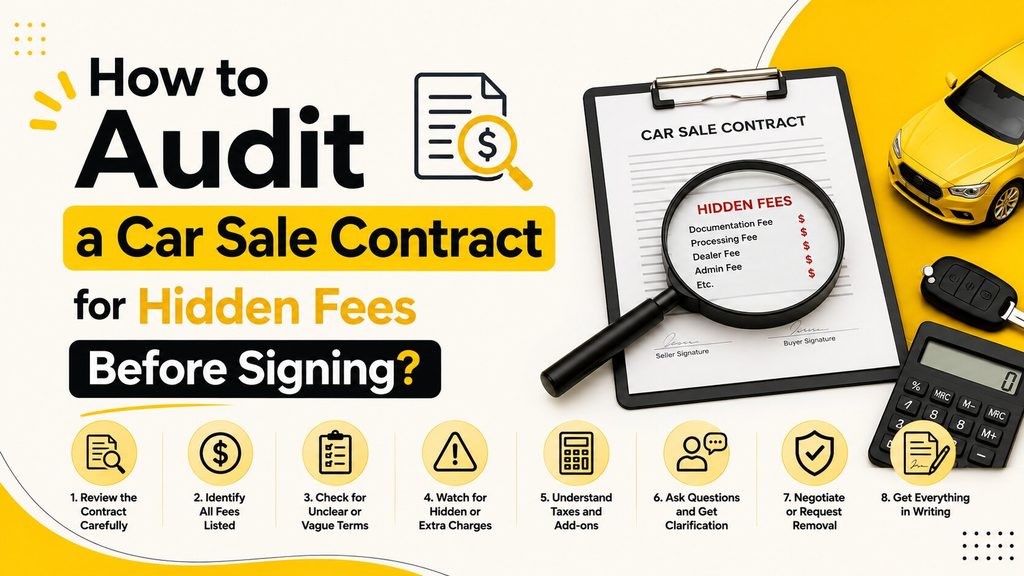
Why You Should Not Rush the Final Paperwork?
The negotiation may feel finished once you agree on the car’s selling price. It isn’t. The finance office is where the final numbers, financing terms, insurance products, warranties, and dealer add-ons can appear in the paperwork.
Many buyers also make the mistake of focusing on the monthly payment instead of the total cost. A salesperson or finance manager may make a higher-priced deal appear affordable by extending the loan from 60 months to 72 or 84 months. The monthly payment may fall, but the total interest can rise substantially.
That is why the most useful question is not “What will my monthly payment be?” It is “What is the total amount I am paying for this vehicle, and what exactly is included?”
Read How to Finance Car Flipping Business: A Professional Guide
Why The First Contract Review Matters?
A car purchase is different from buying something that can simply be returned the next day. Once you sign the required purchase and financing documents, the transaction may become legally binding, depending on the jurisdiction and the specific contract.
That means the best time to find a hidden fee is before you sign.
Do not let the pressure of sitting in the finance office make you rush. Take the documents with you, read them carefully, and ask questions about anything you do not understand.
You do not need to be an expert in auto financing. You simply need to make sure the numbers you agreed to are the numbers appearing in the contract.
Which Car Dealership Fees Are Legitimate?
Not every fee on a car contract is a hidden fee. Some charges are required by the government, some are legitimate dealer charges, and others are optional products or services.
The exact rules vary by state, province, and vehicle type, so you should not assume that a fee is illegal simply because it has an unfamiliar name. Instead, ask what the charge is for, whether it is required, and whether you agreed to it.
Government taxes, title and registration charges, licensing costs, and other official government fees are generally legitimate. New vehicles may also have a factory destination or freight charge that forms part of the vehicle’s advertised or negotiated cost.
Documentation fees require more attention because rules differ between jurisdictions. Some states regulate or cap these fees, while others give dealers more flexibility. A documentation fee is not automatically a hidden fee, but an unexplained or excessive charge deserves a question.
Which Fees Should Make You Stop And Ask Questions?
Dealer preparation, reconditioning, advertising, electronic filing, nitrogen tire fills, VIN or window etching, paint protection, fabric protection, ceramic coatings, theft-deterrent packages, and similar products deserve closer inspection.
The issue is not always that the product itself has no value. The problem is whether you asked for it, knew its price, and agreed to pay for it.
For example, a dealer may tell you that a vehicle comes with nitrogen-filled tires or a paint protection package. If the charge was already added to the contract, ask whether you can remove it. If the dealer says the product cannot be removed, ask whether the vehicle price can be reduced by the same amount.
An advertised “market adjustment” or additional dealer markup also needs to be visible before you agree to the purchase. A dealer may legally charge a markup in some circumstances, but that does not mean you have to accept it.
| Usually legitimate or government-related | Charges that deserve closer review |
| Sales tax | Dealer preparation or reconditioning |
| Title and registration | Regional advertising charges |
| Licensing fees | Nitrogen tire packages |
| Required government charges | VIN or window etching |
| Factory destination or freight charge | Paint or fabric protection |
| Permitted documentation fee | Ceramic coating |
| Required loan-program charges | Theft-deterrent packages |
| Agreed vehicle price | Additional dealer markup |
The exact treatment of each charge depends on where you live and the terms of the transaction.
How to Get the Full Price Before You Sign?
The strongest protection against hidden fees starts before you visit the dealership.
Ask for a written out-the-door price, often called an OTD price. This should show the vehicle selling price and the applicable taxes, government charges, dealer fees, and other costs that make up the total purchase price.
Do not settle for a salesperson telling you, “The car is $30,000.”
A $30,000 vehicle can become much more expensive after dealer fees, taxes, optional products, financing charges, and other items are added.
Your written quote gives you something to compare with the final contract. If the numbers change, you can immediately ask why.
Build Your Own Numbers Before Going To The Dealership?
You can also calculate your expected payment before you arrive. Use the negotiated vehicle price, trade-in value, down payment, estimated taxes and fees, interest rate, and loan term.
You do not need complicated software. A spreadsheet or reliable auto loan calculator is enough.
The purpose is not to predict the lender’s exact final payment. It is to give you a reference point.
If you expect to finance $25,000 at a particular APR for 60 months and the contract suddenly shows $29,000 financed for 72 months, you know that something changed.
That gives you a reason to stop and review the paperwork instead of simply accepting the new monthly payment.
How to Check the Car Contract Line by Line?
Once the finance manager gives you the final documents, put your original written offer beside the contract.
Start with the vehicle itself. Check the year, make, model, VIN, selling price, mileage where applicable, and any agreed equipment. Then check your trade-in allowance and the amount still owed on your trade.
The numbers should match what you agreed to.
Next, review the section showing the amount financed. In many U.S. transactions, the retail installment sales contract contains an Itemization of Amount Financed or similar section. This is one of the most useful places to look for unexpected charges.
A fee can be easy to miss when it is buried among abbreviations and product names.
Watch For GAP, VSC, And Other Codes
GAP usually refers to Guaranteed Asset Protection. It can help cover the difference between what you owe on a vehicle and what an insurer pays after a covered total loss.
VSC commonly means Vehicle Service Contract. It is generally an extended service or warranty-type product.
ETR may refer to Electronic Title and Registration or a similar electronic processing service, depending on the dealer and jurisdiction.
These products are not automatically fraudulent or useless. The important question is whether you knowingly purchased them and whether the price is what you agreed to.
If you do not recognize a code, ask the finance manager to explain it in plain language.
Then ask:
“Did I agree to purchase this?”
If the answer is no, ask why it appears in the contract.
How to Find Hidden Fees and Add-Ons?
Hidden fees are not always hidden in the literal sense. They may be printed clearly on the contract but buried among dozens of other numbers.
Look for charges that were not included in your original quote. Pay particular attention to products added after you agreed on the vehicle price.
A $200 etching fee may not look significant by itself. A $1,500 protection package may be harder to overlook. But several smaller charges can also change the final amount substantially.
Check for dealer prep, reconditioning, paint protection, fabric protection, ceramic coating, window tint, VIN etching, nitrogen tires, theft-deterrent products, service contracts, GAP coverage, and other optional products.
You should also check whether the same service appears twice under different names.
For example, you might see one electronic filing charge in the dealer fees and another similar charge elsewhere. Ask whether both are required and what each one covers.
Ask about every unfamiliar fee
You do not need to argue about every charge. Start with a simple question:
“What does this fee pay for, and is it required?”
Then ask:
“Can I decline it?”
If the product is optional and you do not want it, tell the dealer to remove it before signing.
If the dealer says it cannot be removed, ask them to show you where that requirement appears in the contract or applicable rules.
A legitimate charge should be explainable.
Check the APR, Loan Term, and Monthly Payment
A contract audit should not stop with dealer fees. The financing section can change the cost of the car just as much as a hidden add-on.
First, check the Annual Percentage Rate (APR) against the rate you were approved for. If your bank or credit union already approved you for financing, compare that offer with the dealership’s financing terms.
Then check the loan term.
A deal that was discussed as a 60-month loan should not quietly become a 72- or 84-month loan simply because the longer term produces a payment you like.
The monthly payment alone can hide a more expensive deal.
For example, imagine you can afford a $500 monthly payment. Extending the loan may bring the payment closer to that number, but you could end up paying interest for two additional years.
Also check the amount financed, finance charge, total of payments, and number of payments where those figures appear in the contract.
These numbers tell you much more than the monthly payment.
Check Your Trade-In and Down Payment
Your trade-in can create another place for errors to appear.
If the dealer offered you $12,000 for your old vehicle, make sure the contract shows the same trade-in allowance.
Then check the payoff amount if you still owe money on the trade.
Suppose you owe $8,000 and the dealer gives you $12,000 for the trade. You have $4,000 in positive equity before considering other adjustments.
If the contract shows a different trade value or payoff amount, stop and ask for an explanation.
Negative equity also needs to be clear. If you owe more on your old vehicle than the dealer allows for it, the difference may be added to your new loan. That can make the new vehicle appear affordable while increasing the amount you finance.
Your down payment should also be reflected correctly.
If you planned to put $5,000 down and the contract shows $3,000, do not sign until the difference is explained and corrected.
What to Do If You Find a Fee You Did Not Approve?
Do not sign first and plan to argue about the charge later.
If you find an unfamiliar fee, ask the finance manager to explain it. If it is an optional product you do not want, request its removal.
For a negotiable dealer fee that you believe is excessive, you can ask the dealer to reduce the vehicle’s selling price by the same amount. The important thing is to get the agreed change reflected in the written paperwork.
Do not rely on a verbal promise that the charge will be removed later.
If you make a change to a paper contract, make sure the final version clearly reflects the change and that the appropriate parties initial it where required.
Never sign a contract with blank spaces
Blank lines deserve special attention.
If a document contains an empty space where a dollar amount, term, fee, or other important information should appear, ask for it to be completed before signing.
Do not assume someone will “fill it in later.”
You should receive a completed copy of every document you sign.
If the dealer refuses to provide a complete contract or pressures you to sign immediately, that is a good reason to pause the transaction.
Is There a Cooling-Off Period After Buying a Car?
Usually, you should not assume that you have a 24-hour or three-day cooling-off period for a car purchase.
Consumer cancellation rules vary by jurisdiction and by the type of transaction. In many places, a buyer cannot simply return a vehicle the next day because they changed their mind.
That makes the pre-signing review especially important.
Some contracts may contain specific cancellation rights, and certain consumer protection laws may apply in particular circumstances. But you should not sign a car contract assuming you can cancel it later.
If you are unsure about your rights, check the rules in your state or province or speak with an appropriate consumer protection or legal professional.
What to Check During the First 24 Hours?
The first day after purchase is a useful time to review your documents again because you are no longer sitting in a busy dealership office.
Take out every document you received and compare it with the deal you originally agreed to.
Start with the final vehicle price. Then check whether a promised rebate disappeared, whether a market adjustment appeared, or whether an unexpected dealer fee was added.
Next, review the financing terms. Confirm the APR, loan length, amount financed, monthly payment, and total payment figures.
Then look for products you did not request. GAP coverage, service contracts, paint protection, theft-deterrent products, window etching, and other add-ons should all be clearly identified.
Your trade-in deserves another review too. Check the agreed trade value, payoff amount, and any negative equity transferred into the new loan.
What If You Find An Error After Signing?
Contact the dealership as soon as possible and keep your communication in writing.
Point to the exact document and line where the problem appears. Explain what you agreed to and what the final contract shows.
For example:
“My signed buyer’s order shows a $12,000 trade allowance, but the final contract shows $10,000. Please explain and correct the discrepancy.”
A specific written complaint is much stronger than saying that the deal “looks wrong.”
If the dealer refuses to address a serious discrepancy, you can consider contacting your lender, state or provincial motor vehicle regulator, consumer protection agency, or another appropriate authority depending on where the transaction occurred.
Conclusion
Before you sign, make sure the vehicle price, trade-in value, down payment, taxes, dealer fees, add-ons, APR, loan term, amount financed, and monthly payment all make sense.
More importantly, make sure you know what every charge represents.
The safest approach is simple: negotiate the out-the-door price first, review the contract second, and discuss optional products only after you understand the actual cost of the car.
Do not let a low monthly payment distract you from a higher total price. Do not accept an unfamiliar fee simply because it is printed on the contract. And never sign paperwork with important blank spaces.
A few extra minutes in the finance office can save you from paying thousands of dollars for products, fees, or financing terms you never intended to accept.
Frequently Asked Questions
How do I spot hidden fees on a car contract?
Compare the final contract with your original written out-the-door quote. Look for new dealer fees, optional products, service contracts, GAP coverage, protection packages, documentation charges, and other amounts that were not part of the original agreement.
What is an out-the-door price?
An out-the-door price is the total price you expect to pay for the vehicle after applicable taxes, dealer fees, government charges, and other required costs are included. Asking for this number in writing makes it much easier to compare the original deal with the final contract.
Can a dealer add fees after agreeing on a price?
A dealer may have legitimate charges that were not included in an initial vehicle-price discussion, depending on the advertisement, written quote, and local rules. However, you should ask for a complete itemized price before signing and question any charge that appears unexpectedly.
Can a dealer change the interest rate before I sign?
The final financing terms depend on the lender approval and the actual contract. If the APR in the final paperwork is different from the rate you expected, stop and ask why before signing. Do not accept a higher rate simply because the dealer says the payment is still affordable.
Can I refuse GAP insurance or an extended warranty?
If the product is optional, you can generally decline it. Read the contract carefully because GAP coverage, service contracts, warranties, and other products may be listed separately from the vehicle price.
Can I cancel a car purchase the next day?
Do not assume you can. A general cooling-off period does not apply to every vehicle purchase. Your rights depend on the jurisdiction, transaction, and contract. Check the applicable rules before signing rather than relying on the idea that you can return the car within 24 hours.
What should I do if I find a hidden fee after signing?
Review the signed documents, identify the exact charge, and contact the dealer promptly in writing. Ask for an explanation and correction if the charge does not match your agreement. Keep copies of the contract, buyer’s order, emails, messages, financing documents, and other records.