
Usually, no. Most major Canadian reverse mortgage lenders do not accept manufactured or mobile homes as standard eligible properties. However, a manufactured home may be considered in limited cases if it is permanently attached to a foundation, classified as real property, located on land you own, and meets the lender’s appraisal and property requirements.
The key issue is not simply whether the home is called a manufactured home. The land, legal title, foundation, property classification, value, and lender’s rules all matter.
If your home sits on leased land or a rented pad in a mobile home park, a traditional Canadian reverse mortgage is generally not available. If you own both the home and the land and the home is permanently attached to the property, you may have a better chance of getting it reviewed.
| KEY POINTS |
| Getting these answers before ordering an appraisal can prevent unnecessary costs. Yes, it may be possible in limited cases, but most manufactured and mobile homes do not qualify with mainstream Canadian reverse mortgage providers. Your chances are better when you own both the manufactured home and the land, the home is permanently attached to a foundation, it is classified as real property, and it meets the lender’s value, condition, location, and appraisal requirements. A manufactured home on leased land or a rented pad is generally not eligible for a traditional Canadian reverse mortgage. U.S. HUD and FHA rules can explain some of the information you may see online, but they do not determine Canadian eligibility. Canadian homeowners should focus on their land title, property classification, foundation, appraised value, and the specific lender’s rules. If you own a manufactured home, the best first step is to give a lender or mortgage broker the property’s exact details and ask whether the lender will consider it before paying for a formal appraisal. Approval is lender-specific and case-by-case, so do not assume that meeting one requirement guarantees approval. |
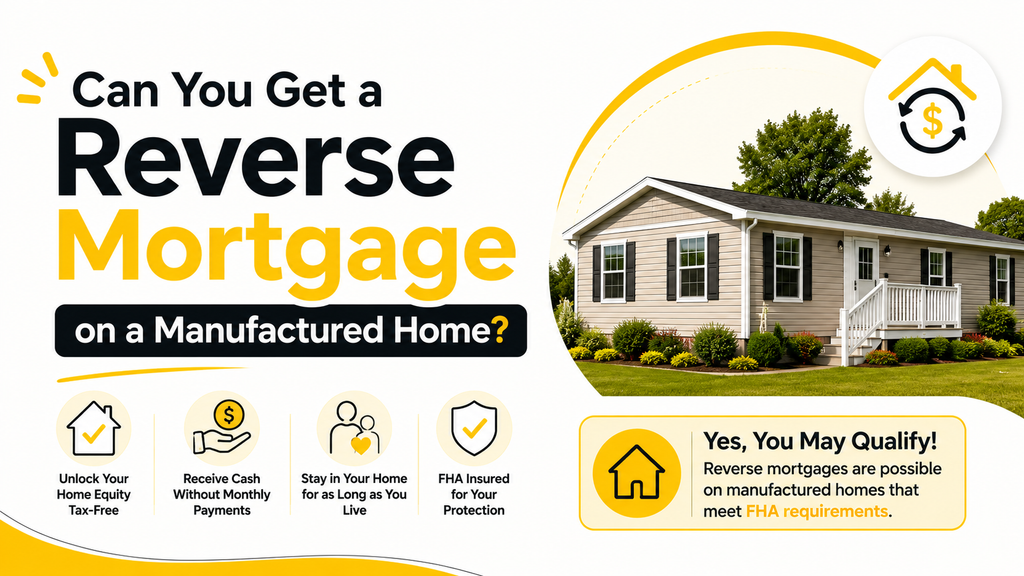
Quick Answer
| Your situation | Reverse mortgage chance |
| Manufactured home on leased land | Generally not eligible |
| Mobile home in a rented-pad community | Generally not eligible |
| Manufactured home on land you own | May be considered |
| Permanently attached to a foundation | Helps eligibility |
| Home is classified as real property | Important requirement |
| Home is your primary residence | Required |
| All owners are 55 or older | Required for Canadian programs |
| Home meets the lender’s minimum value | Required |
Canada vs. U.S. Reverse Mortgage Rules for Manufactured Homes
Canadian homeowners can find very different answers online because U.S. reverse mortgage programs have detailed rules specifically for manufactured housing.
The distinction matters. U.S. HUD and FHA manufactured-home requirements do not determine whether a manufactured home qualifies for a Canadian reverse mortgage. Canadian lenders use their own property, title, appraisal, and lending requirements.
| Issue | Canada | United States |
| Typical reverse mortgage age | 55+ for Canadian programs | 62+ for HECM |
| Land ownership | Usually required for manufactured homes | Generally required |
| Leased land | Usually a major disqualifier | Typically does not qualify for HECM |
| Property classification | Real property is important | Must generally be classified as real estate |
| Foundation | Permanent attachment can improve eligibility | FHA/HUD foundation requirements apply to qualifying HECM manufactured homes |
| Minimum size | Lender-specific | HECM manufactured homes generally require at least 400 sq. ft. |
| Construction date | No general Canadian HUD date rule | HECM manufactured homes generally must meet post-June 15, 1976 standards |
| HUD certification labels | Not a Canadian requirement | Required for qualifying FHA/HECM manufactured homes |
| Main deciding factor | Canadian lender’s property and underwriting rules | HUD/FHA and lender requirements |
The U.S. rules are useful for comparison because they explain why many online articles mention June 15, 1976, HUD certification labels, permanent foundations, and 400 square feet. Those are U.S. HECM requirements. A Canadian homeowner should not use them as a checklist for Canadian eligibility.
For a Canadian application, the more important questions are whether you own the land, whether the home is treated as real property, whether it is permanently attached, and whether the lender is willing to accept that type of property.
Why Most Manufactured Homes Do Not Qualify?
The biggest problem is land ownership.
A reverse mortgage is secured against real estate. If you own the manufactured home but only rent the land underneath it, the lender may not have the type of real-estate security it requires. This is why homes in mobile home parks and land-lease communities are usually excluded.
A second issue is how the home is legally classified. A lender is more likely to consider a manufactured home when it is permanently attached to the land and treated as real property rather than movable personal property.
The home’s market value and location also matter. Canadian reverse mortgage programs commonly have minimum property-value requirements around $250,000, while some lenders may require $300,000 or more. Rural or remote properties can face additional restrictions because the lender needs an appraisal and enough comparable sales to establish a reliable value.
Mobile Home vs. Manufactured Home: Does the Name Matter?
The terms can cause confusion.
In U.S. lending rules, the term mobile home is often associated with homes built before June 15, 1976, while homes built after that date are generally referred to as manufactured homes under federal standards.
That date is important for U.S. HUD/FHA programs. It is not a Canadian reverse mortgage eligibility rule.
For a Canadian homeowner, the more useful distinction is whether the property is legally treated as real estate and whether you own the land. A manufactured home that is permanently attached to freehold land is very different from a mobile home sitting on a rented pad.
The lender will look at the actual property and its legal status rather than relying only on the label used to describe the home.
What If You Own the Land?
You have a better chance if you own the land on which the manufactured home sits.
For a lender to consider the property, the home would generally need to be permanently affixed to a foundation and included as part of the real estate. The property must also meet the lender’s condition, appraisal, location, and value requirements.
That still does not mean approval is guaranteed. Canadian reverse mortgage providers do not generally advertise manufactured homes as a standard eligible property category. A lender may review the property individually and decide that it does not meet its requirements.
Before paying for an appraisal, ask the lender or mortgage broker specifically:
“Do you accept a manufactured home that I own, permanently attached to a foundation, on land that I also own?”
That question can save you time and an unnecessary appraisal expense.
What If the Manufactured Home Is on Leased Land?
A manufactured home on leased land is generally not eligible for a traditional Canadian reverse mortgage.
This includes many mobile home parks and land-lease communities where the homeowner owns the structure but pays rent for the lot. The problem is that the borrower does not own the underlying land that normally forms part of the lender’s real-estate security.
The same issue can arise with other arrangements where the homeowner owns the structure but does not hold the required ownership interest in the land.
If you are in this situation, ask about other home-equity options rather than assuming a reverse mortgage will be available.
What Are the Basic Reverse Mortgage Rules in Canada?
For a Canadian reverse mortgage, all owners on title generally need to be at least 55 years old. The home must normally be your primary residence, meaning you live there for at least six months of the year.
The property also needs to meet the lender’s requirements for value, condition, location, and marketability. Most standard reverse mortgage programs focus on conventional residential properties such as detached houses, semi-detached homes, townhouses, and condos. Manufactured and mobile homes may have restrictions or may be declined.
You can typically access up to about 55% of the home’s appraised value, but that is a maximum rather than an amount every borrower receives. The actual amount depends on factors such as your age, property value, location, and lender.
For example, a 55-year-old homeowner should not assume that a $400,000 property automatically produces $220,000 of available equity. The amount offered can be much lower, particularly for younger borrowers.
Does the Home Need to Be Worth a Certain Amount?
Yes. The lender needs the property to have enough value to support the reverse mortgage.
A $250,000 minimum property value is a useful general benchmark for many Canadian programs, although some lenders may require $300,000 or more. Manufactured homes can face an additional challenge if their location, condition, or type makes them difficult to value.
The appraisal is especially important because the lender needs to know what the property could reasonably sell for if the reverse mortgage eventually has to be repaid.
What Does a Reverse Mortgage Cost?
A reverse mortgage can provide access to home equity without requiring regular mortgage payments, but it is usually more expensive than a standard mortgage or HELOC.
The interest is added to the balance over time, so the amount owed can grow even when you make no monthly payment. Borrowers may also have appraisal, legal, setup, and closing costs. Prepayment charges may apply depending on the lender and the mortgage terms.
Canadian borrowers should also expect to obtain independent legal advice before approval.
The choice between receiving the money as a lump sum, taking smaller amounts over time, or using scheduled payments can also affect how quickly interest accumulates.
Can a Reverse Mortgage Affect OAS or GIS?
A reverse mortgage gives you access to some of the equity already built up in your home. The treatment of the money you receive can depend on how the funds are handled and on your overall financial situation.
Do not assume that taking a reverse mortgage will automatically reduce or preserve every government benefit. Check your specific situation with the relevant government program or a qualified financial professional before relying on the proceeds for OAS or GIS planning.
The safest approach is to separate the mortgage question from the benefits question. First determine whether the property qualifies for the reverse mortgage. Then confirm how receiving and holding the proceeds could affect your particular benefits.
What Happens When You Get a Reverse Mortgage?
You continue to own your home. The lender provides money based on the equity in the property, and the balance grows as interest is added.
You generally do not make regular mortgage payments. The reverse mortgage becomes repayable when a triggering event occurs under the mortgage agreement, such as selling the home, moving out permanently, or the death of the last borrower.
You must still meet your obligations as a homeowner. That includes keeping the property maintained and staying current on property taxes and insurance.
Can a Manufactured Home Owner Use a HELOC Instead?
Possibly. If a reverse mortgage is unavailable because of the property’s classification, land tenure, value, or lender restrictions, a HELOC or another home-equity product may be worth discussing with a mortgage professional.
The same property issues can still affect eligibility, so owning the land and having the home classified as real property can remain important.
A conventional refinance may also be an option depending on your income, credit, existing mortgage, equity, and the property’s eligibility with the lender.
What Should You Check Before Applying?
Start with the property documents rather than the loan application.
Check whether you own the land, how the home appears on the title, how it is classified for property-tax purposes, and whether it is permanently attached to a foundation. Then check the property’s estimated market value and whether there are any unusual land-lease or community restrictions.
After that, contact a reverse mortgage lender or qualified mortgage broker and explain exactly what type of manufactured home you own.
Ask these questions:
- Do you accept manufactured homes?
- Does the lender require the borrower to own the land?
- Does the home have to be permanently attached to a foundation?
- Does the property need to be classified as real property?
- What is the minimum property value?
- Are rural or remote properties restricted?
- Is approval available on a case-by-case basis?
- What appraisal and legal costs apply?
Frequently Asked Questions
Can you get a reverse mortgage on a mobile home in Canada?
Usually not. Most mainstream Canadian reverse mortgage providers have restrictions on mobile and manufactured homes. A property may have a better chance if the borrower owns the land, the home is permanently attached to a foundation, and it is classified as real property.
Can you get a reverse mortgage on a manufactured home you own?
Possibly. Owning both the manufactured home and the land improves the situation, but the lender must still accept the property type and approve its value, condition, location, and legal classification.
Can you get a reverse mortgage on a manufactured home in a mobile home park?
Generally no if you only own the home and lease the pad. Land-lease arrangements are a major restriction for traditional Canadian reverse mortgages.
Do Canadian reverse mortgages require you to be 55 or older?
Yes, for the major Canadian reverse mortgage programs, all owners on title generally must be at least 55. The exact lending amount can vary based on age and other property factors.
Can you borrow 55% of a manufactured home’s value?
Up to about 55% is a program maximum, not a guaranteed amount. The actual amount depends on age, property value, location, lender requirements, and whether the manufactured home is accepted at all.
Do U.S. HUD rules apply to a Canadian reverse mortgage?
No. U.S. HUD and FHA rules apply to U.S. programs. Canadian lenders use Canadian lending and property requirements. The U.S. rules about the June 15, 1976 construction date, HUD labels, and 400-square-foot minimum should not be treated as Canadian requirements.
Is there a cooling-off period for a Canadian reverse mortgage?
There is no universal statutory cooling-off period that should be assumed for every Canadian reverse mortgage. Borrowers should review the lender’s contract and obtain the required independent legal advice before proceeding.
What happens if my manufactured home does not qualify?
You can ask a mortgage professional about other ways to access equity, such as a HELOC, refinance, or another home-equity product. Eligibility will depend on the property, your financial situation, and the lender’s requirements.